Words on Rope
Shibari as mindfulness.
How the slow, attentive practice of rope can become a way of being fully present.
Presence
An invitation to slow down.
Most of modern life pulls our attention in many directions at once. Shibari asks for the opposite. To tie well, you have to be here, in this moment, with this rope and this person. There is no rushing a wrap, no skipping a check-in, no thinking about tomorrow while your hands are working.
This is why so many people describe Shibari not only as an art form, but as a mindful practice. It creates a space where attention narrows, the noise fades, and what remains is the simple, focused experience of being present.
Breath
Breath and body awareness.
Breath is at the heart of many mindful practices, and Shibari is no exception. The person being tied often becomes more aware of their breathing as the rope settles, noticing how the body softens, holds or responds. The person tying learns to read that breath, using it as a quiet signal of comfort, tension or ease.
Over time, both people develop a deeper awareness of the body: where tension lives, how stillness feels, and how small changes in pressure or position are felt. This kind of awareness is something many practitioners carry with them long after the rope comes off.
Attention
The rope as an anchor.
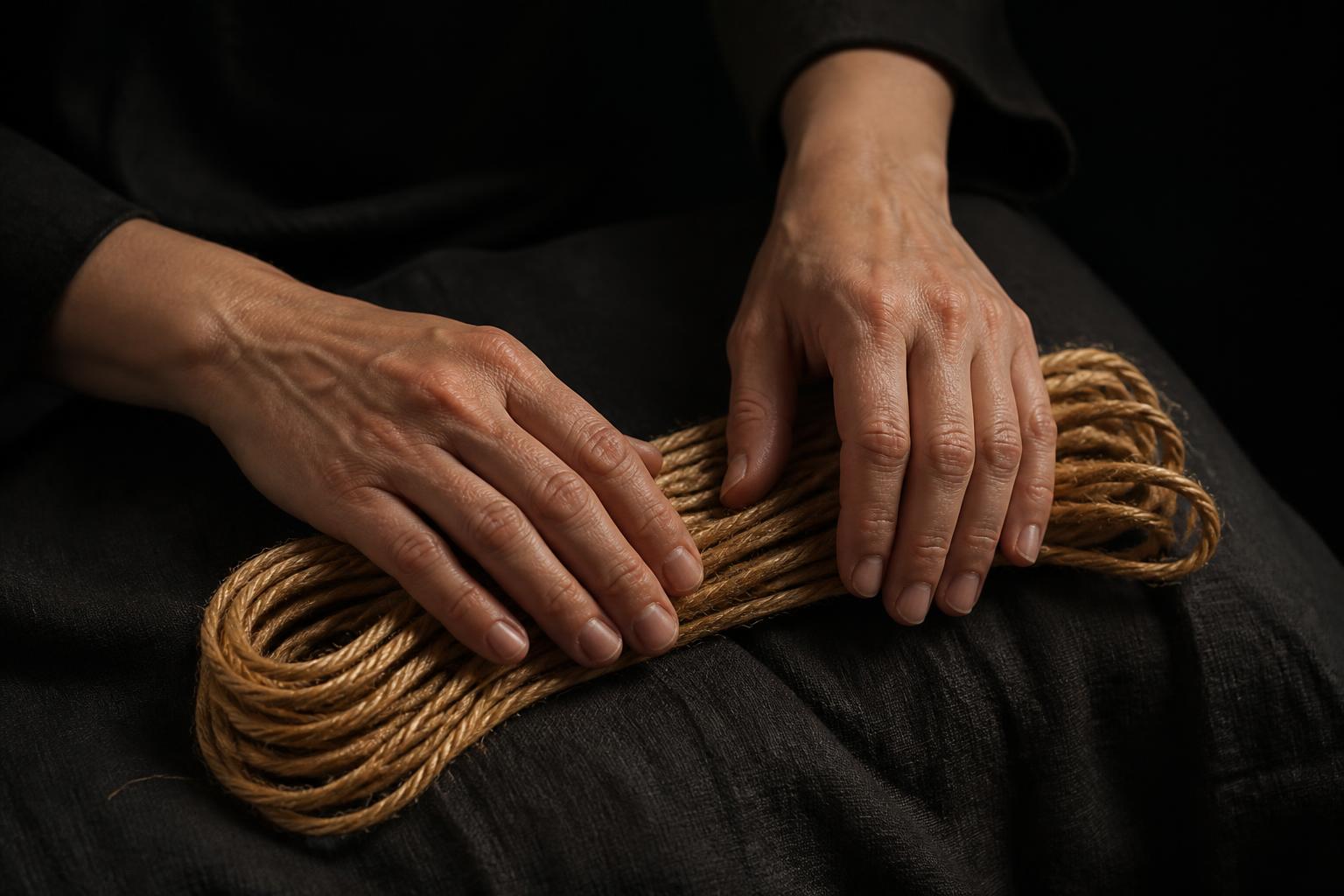
In meditation, the breath is often used as an anchor, something to return to when the mind wanders. In Shibari, the rope can play a similar role. The texture of the jute, the rhythm of each wrap and the steady movement of the hands give the mind something to rest on.
For the person tying, the repetition of foundational ties can become almost meditative, with the focus moving from the mind into the hands. For the person being tied, the feeling of the rope can bring attention gently back to the body whenever thoughts begin to drift.
Connection
Presence, shared.
What makes Shibari different from solitary practices is that it is usually shared. Two people practising mindfully together create a particular kind of connection, built on attention, trust and communication beyond words.
At Shibari ME, we approach Shibari as an art form and a shared language. For some, the practice also carries a spiritual dimension: a space for mindfulness, vulnerability, surrender and self-discovery. Its meaning is always shaped by the people who practise it.
In practice
Practising mindfully.
A few simple principles help bring mindfulness into rope:
Begin with intention. Take a moment before you start to arrive, breathe and agree on what you both hope to experience.
Move slowly. Speed is rarely the goal. Slower movements allow both people to notice more and respond with care.
Stay in communication. Mindfulness never replaces check-ins. Presence and clear communication work together, both verbally and nonverbally.
Close with care. When the rope comes off, take time to come back together, breathe and share what you noticed.

Safety
Mindfulness and safety go together.
Being present makes you a safer practitioner. When your attention is fully on the moment, you are more likely to notice early warning signs, such as changes in breath, colour or comfort. But mindfulness is no substitute for proper training. Understanding how rope interacts with the body comes from learning in person with experienced teachers. Read more in Is Shibari safe?
Begin
Mindful rope in Dubai and the UAE.
At Shibari ME, every journey begins with Shibari 101, where you learn safe rope handling, communication and your first ties in a calm, welcoming and discreet setting in Dubai and across the UAE and the GCC. Many of our community discover that the practice becomes a moment of stillness in their week.
Read more in What is Shibari? and The history of Shibari, explore our Shibari classes, or get in touch with any questions.